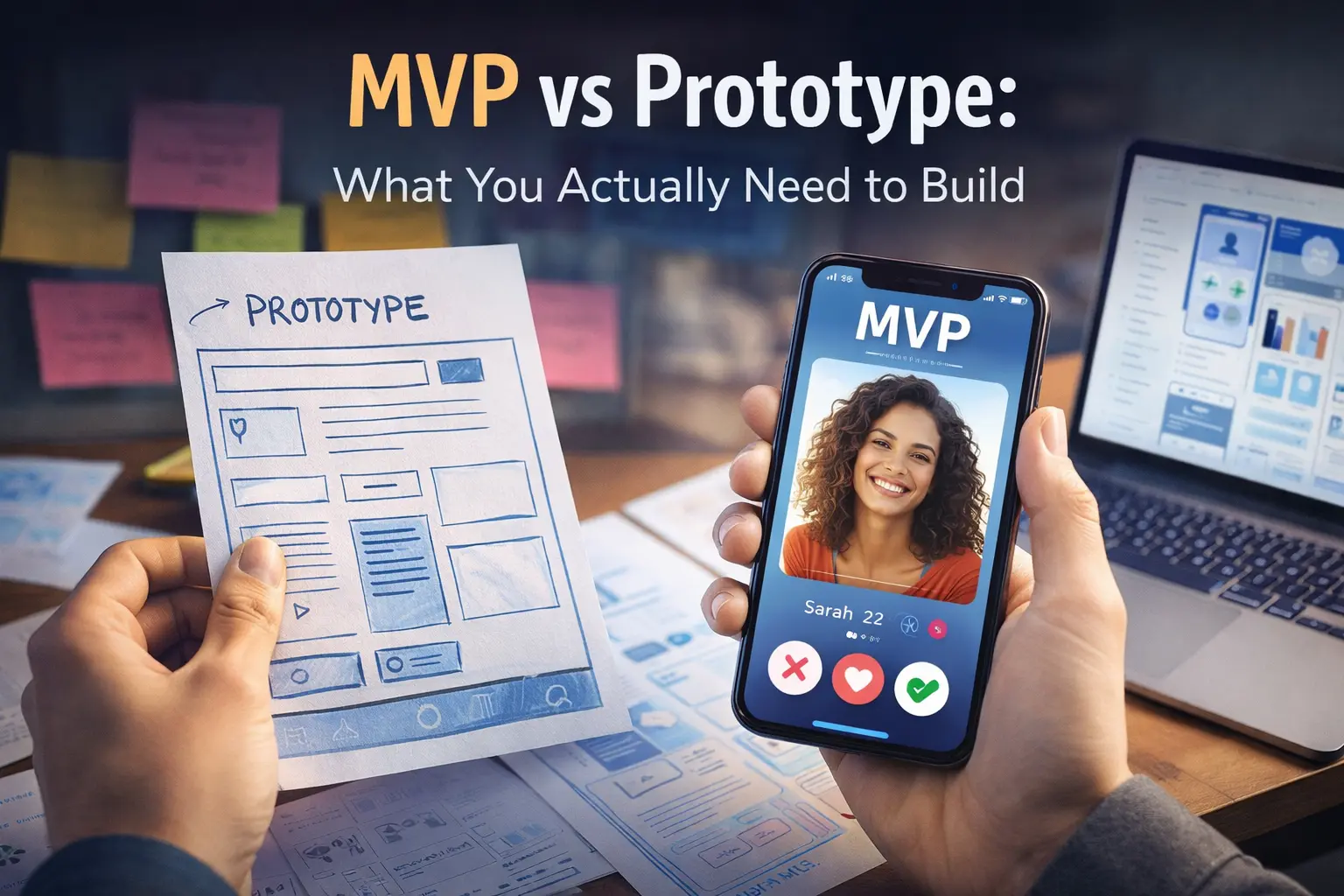
Founders often confuse prototypes with MVPs. They're different tools for different stages, and mixing them up is expensive.
What's a Prototype?
A prototype answers the question: "Will this solve the problem?" It's disposable. It doesn't scale. It might be held together with no-code tools and duct tape. That's fine—it's meant to learn, not to last.
Build a prototype when:
- You're testing a new concept
- You need to show investors a vision
- You're validating whether users understand the value prop
What's an MVP?
An MVP answers: "Can we deliver this value repeatedly?" It's production-grade. It handles edge cases. It won't collapse under load. It's the foundation you'll build on.
Build an MVP when:
- You've validated the problem exists
- You have paying users (or a waitlist)
- You're ready to iterate based on real usage data
The Cost Difference
A prototype might cost ₦2M and take 3 weeks. An MVP might cost ₦8M and take 10 weeks. But here's the trap: building an MVP before validating assumptions means you might spend ₦8M on something nobody wants.
Our Validation Framework
We use a three-stage approach:
- Problem validation: User interviews, market research (no code yet)
- Solution validation: Clickable prototype, landing page tests
- Business validation: Working MVP, payment integration, analytics
When to Skip the Prototype
Sometimes you can go straight to MVP:
- You're in a well-understood market with clear demand
- You're rebuilding something that already works elsewhere
- You have pre-sold the product and need to deliver
The Real Question
Don't ask "What's the fastest way to build this?" Ask "What's the fastest way to validate this?" Then build the minimum artifact that answers that question.